


Since 2021, Marshall Gu has been an absolute powerhouse on this website, with over 60 full discography overviews, from artists as disparate as Morton Feldman to Future to Phelimuncasi. In between all that, he somehow found the time to write a 33/3 on Krautrock. The man is a machine, and I was all too happy to indulge his inner hater on this newest Vince Staples. Here’s a transcript of our conversation.
Marsh: I don’t think Cry Baby is Vince Staples’ worst album, I don’t think it’s nearly as good as people make it out to be. It’s not at all unique in terms of his overall discography, and I also don’t think it’s political in the slightest. Or if it is political, it’s just political vibes. He’s just pointing out things that everyone knows are bad, and he’s saying “wow, these things are bad.” I don’t think that’s political writing, or at the very least, smart political writing, and when people talk about the album as a “rap rock” record, I’m just like wow you guys are out of your mind because it’s not a rock album since there’s no rock to speak of! It rocks as much as a Black Keys album.
Eli: It was really funny, people were getting mad though like “No, it actually sounds more like Interpol or TV on the Radio,” and I’m like, “Alright, come on, like I’m not the biggest fan of those bands but that’s just mean to them.” It very much does sound like soundtrack rock that you hear before like an MLB game.
Marsh: Exactly. It sounds like Honda commercial rock music. The guitars only exist to serve Staples; they’re never loud, they’re never bracing. The same goes for the drum beats. And if you told me that real people are there playing these instruments, I wouldn’t believe you. And yet I’m pretty sure most of it is live. Which is crazy! I think it’s crazy to hire live musicians just to treat them like samples, and I think the only time they’re allowed to actually play a little bit of music is in the fade out of the very last song. It just doesn’t feel like an organic rap rock album in the slightest to me, although rap rock has always been problematic.
Eli: Like a stepchild.
Marsh: Exactly, a bastard between two genres that are trying to appeal to two different populations and appealing to no one.
Eli: It’s hard to properly put it into words, but there’s a severe lack of bite in production of a lot of things now. When I was talking about that Olivia Rodrigo record, I didn’t go that in depth just because I was being flippant, but people were praising that song “Expectations.” Actually, let’s talk about the critics, indulge me here, like Tom Breihan. You’re slurping Olivia for being a big pop star now. I see you, bro. Get the fuck off her dick. But there’s just nothing there. No bite. Like, if you want to do that kind of style, you got to go straight back to fucking analog recording. You have to go back to a specific kind of sound to really make that work. That’s been a problem with all the 80s-type records, the Dua Lipa’s, the Jessie Ware’s. It just doesn’t work without that kind of crackling, old production. And the same thing here: rock literally just sounds better when it’s analog recorded.
Marsh: I totally totally agree. Is it the fault of Staples? Or is it the fault of an audience that doesn’t even know what rock music is anymore. If biggest rock band in the world is Imagine Dragons or whatever the fuck it is right now, is it really Staples’s fault that his idea of a rock album sounds so neutered?
Eli: Rock hasn’t been relevant like that at least since around the Strokes and the White Stripes. Obviously, I think Geese got big and they very much are a traditional rock band, and I think the production on that like it serves them really well. In terms of like rock, like, you know, straight down the middle rock like an ACDC or a Hendrix type, no, that doesn’t really exist. It’s sad. This album would be sick if he worked with someone like Josh Homme. Like that Queens of the Stone Age, Thee Oh Sees style certainly could have worked, but that requires just a lot more abandon.
Marsh: It takes a little more, not to be mean, more vision to pull that off. The Staples of 2017-2018 coming right off of Big Fish Theory where he had a lot of creativity might have been able to pull it off back then, but the Staples who has been coasting for quite some time now just doesn’t have the fire. A lot of these beats just sound like Gorillaz tracks to me. If you told me “White Flag” or “Go Go Gorilla” was a Damon Albarn song, I would totally believe you.
Eli: It’s like how Damon Albarn just grabs rappers from random. Yes, Vince is on a Gorillaz song, so it’s exactly how he’ll just put a random rapper on a non-offensive soft rock alt rock song.
Marsh: Exactly. We’re literally just missing a Damon Albarn low-key melody or chorus here and there and then they could have just billed this as a collaboration between the two and it would have gotten like five times as many listeners. Do we want to backtrack a little bit and talk about Staples in general? Are you a Staples fan?
Eli: Not really. It’s funny, my friend Jayson Buford wrote about this the other day, and more people got mad at him for being very earnest, and you know, not even trying to be cheeky like I am, and he basically said, “Vince is an incredible rapper, a great rapper, but he doesn’t seem that interested in rap, and that turns me off of him.”
Marsh: Yeah, I saw and read the Jayson Buford substack, and it was so fresh to have a dissenting voice because I thought I was going a little crazy with all the praise and I was disappointed with what I saw on Twitter and Reddit where people were sharing that article with bad faith interpretations of what he was saying. I think he’s very correct when he writes that Staples is a good rapper that seems scared of his own rapping or doesn’t seem like he wants to be a rapper. Staples never wanted to be a rapper! He fell into rap, he grew up with a really troubled past, he was couch surfing, and then he discovered Odd Future, and then he tried rapping because he needed a job, he needed to make money, and I don’t think he expected to be as big as he is now. I’m pretty sure he thought about quitting music when it wasn’t going his way at first! And when he became a huge rapper around like Summertime ‘06 and Big Fish Theory and when he was getting crowds, he just seemed to not care anymore about rapping. He put out FM!, which I know you like, but I personally don’t really care for.
And it was like his way of distancing himself from all the acclaim and popularity. He’s like, you know what? I don’t want to be making records like Summertime ‘06 or Big Fish Theory anymore. I just want to do some low key raps and some bangers and talk about the streets a little bit and that’s totally fine, but I think Buford had a really good point that the west coast debate of the 2010s could have been about Kendrick Lamar versus Vince Staples but Vince Staples just sort of wrote himself out. He collaborated with Kendrick Lamar a couple times on “Yeah Right” and the Black Panther soundtrack and was like “Nah, see ya, bye.” And that’s fine, you can do whatever you want as a rapper or as an artist. But for Vince Staples, it was disappointing to watch him retreat into really short albums that had no consequence whatsoever. You put them on, you nod along, and then they would end, and you would be like, “I like that,” and you would move on with your life and never think about them again.
Eli: I really did like Buford’s thing, and I think people got mad about that kind of psychoanalysis; that Jayson was asserting something that they didn’t personally think. And it’s not my particular framing. I don’t think Vince Staples is particularly creative musically. Obviously, it would have been sick to see him on that Kendrick or Tyler level. I think Vince is a better rapper than Tyler, for sure. But Tyler is an obsessive who loves Stereolab, an obsessive about the datpiff era. He’s a nerd that’s involved, and this is probably the record collector-music critic in me scanning that as opposed to like the classic rap fan, but for me, the music really does come first, and if you don’t have the type, vision and dedication in that aspect, it really does fall flat. And I think that’s why that Vince Staples show pivot was great because, you know, I think Vince is like such a worldly guy that it makes sense. He would go into TV, but for music, he’s not necessarily a musician like that.
Marsh: I totally agree. I agree that Staples is a better rapper than Tyler, but whatever Tyler’s faults are, he’s just far more visionary and creative in a way that Vince Staples isn’t. You can see it in their music. Vince Staples was changing a little bit. He did a massive jump to Big Fish Theory and then he stopped jumping whereas Tyler, the Creator is constantly pivoting and doing whatever the fuck he wants which is a level of creativity that’s just beyond Staples’s grasp.
Eli: I don’t think something like Chromakopia is really that good, but it’s very undeniably him, whereas Cry Baby just kind of feels like a record that’s like “Trump is bad!” and “I’m black in America” and it doesn’t feel like anything else. Like okay, put this on Target shelves! It’s kind of like a black American Idiot.
Marsh: Yes! It’s worse than American Idiot!
Eli: Well, American Idiot has bops at least. Great riffs. Cry Baby does not have riffs like that.
Marsh: It has no riffs for a supposed rock album. To your point, there’s no indication of what Staples actually believes on the album. There’s one really good verse where he talks about his past where he “got chokeslammed for resisting arrest from a grown man.” That autobiographical stuff that he’s been doing for the last 15 years is always great. But besides that, there’s a fucking five minute song about how TV controls the masses like what the fuck are we doing? And sure I can give him the benefit of the doubt since a lot of people are saying online, “Oh it’s not actually about tv, it’s about cell phones too,” I’m just like “Whoa. No fucking way.” Are you kidding me? That’s not insightful. That’s not even necessary in 2026. That’s nothing new. Or when he does “Only in America” and he’s talking about gun violence and how that’s “only in America,” did Childish Gambino not do that already in 2018?
Eli: Yeah, and everyone was making fun of him because Donald Glover is cornier.
Marsh: People clued in that the Childish Gambino song had nothing to do with politics if you remove the music video. But Staples also names a song called “Cotton” which has very drastic implications, and the song is about authorities telling him to dance for them, and it’s about his feelings with working with record labels but like there’s nothing there! Just nothing there.
Eli: Far from me, a mixed black man to tell a black man from Long Beach how to treat his relationship to chattel slavery but at the same time, this is like such a deeply fraught topic. It’s either you can say it in a flippant way, like if some drill rapper was talking about picking cotton and treating it as a joke—then it’s almost transgressive, but if you’re doing a thing where you’re trying to be deep then you have to really go for it and be very pointed about how truly psychotically genocidal that was. So if you can’t actually go there and pull it off, it’s so flat, it doesn’t work. It’s a giant creative swing and a miss.
Marsh: Exactly. The whole album feels like listening to someone trying to raise awareness about quote-unquote deep issues with the most surface-level observations you could possibly imagine. There’s even a line about how freedom of speech is not actually free. Like, no shit, Sherlock.
Eli: Yeah, I’ve never heard Gil Scott-Heron in my life, man.
Marsh: I just wish for a political album, this had anything to say politically besides war is bad or America’s problematic. Yeah, absolutely true! But there’s nothing deeper to be gained here.
Eli: It’s funny, the thing these lyrics remind me most is Megadeth. Dave Mustaine is making all these on-the-nose songs, but it works because literally all his songs are the hardest fucking banging tracks juxtaposed with him being kind of a chud but also being like, “we’re also under the threat of nuclear war!” And it’s like, you know what, man? Get your shit off! It just works in that way. Whereas Vince trying almost to be like cool, or like lay it down straight in that suave Gil Scott way, it just does not work at all.
Marsh: It doesn’t work because these topics take a lot a lot more deep thinking than he’s giving us. If you have a song about how war is bad and you’re actually quoting “War! What is it good for?” my attention just dwindles on the spot. There’s also one time my ears really perked up when I first heard the album and it’s the “Cops shot the kid” sample from Slick Rick’s “Children’s Story.” But here’s the problem. When I heard that the first time, I was like “Where have I heard that before?” And then I played it again and again, and I finally clued in: Nas used the exact same sample when he was backed by Kanye West for NASIR which is not a good album by any means, but he already used that sample to better effect, and I think that’s embarrassing.
Eli: It is interesting when you say that because despite all of their faults the generation older than Staples, the Nas’, the Kanye’s, even the Jay’s who are uber-capitalist are more politically savvy than Vince is. You look at something like “The Story of OJ” and even in his 40s, Jay is like much more… they both know what the game is, how black image is used as capital, a sort of racial reconfiguration but Jay just plays it so much cooler with so much more acknowledgement. There is a level of political integration in their lives, in the non-social media internet lives, that I think makes their music better, or at least makes their political music better.
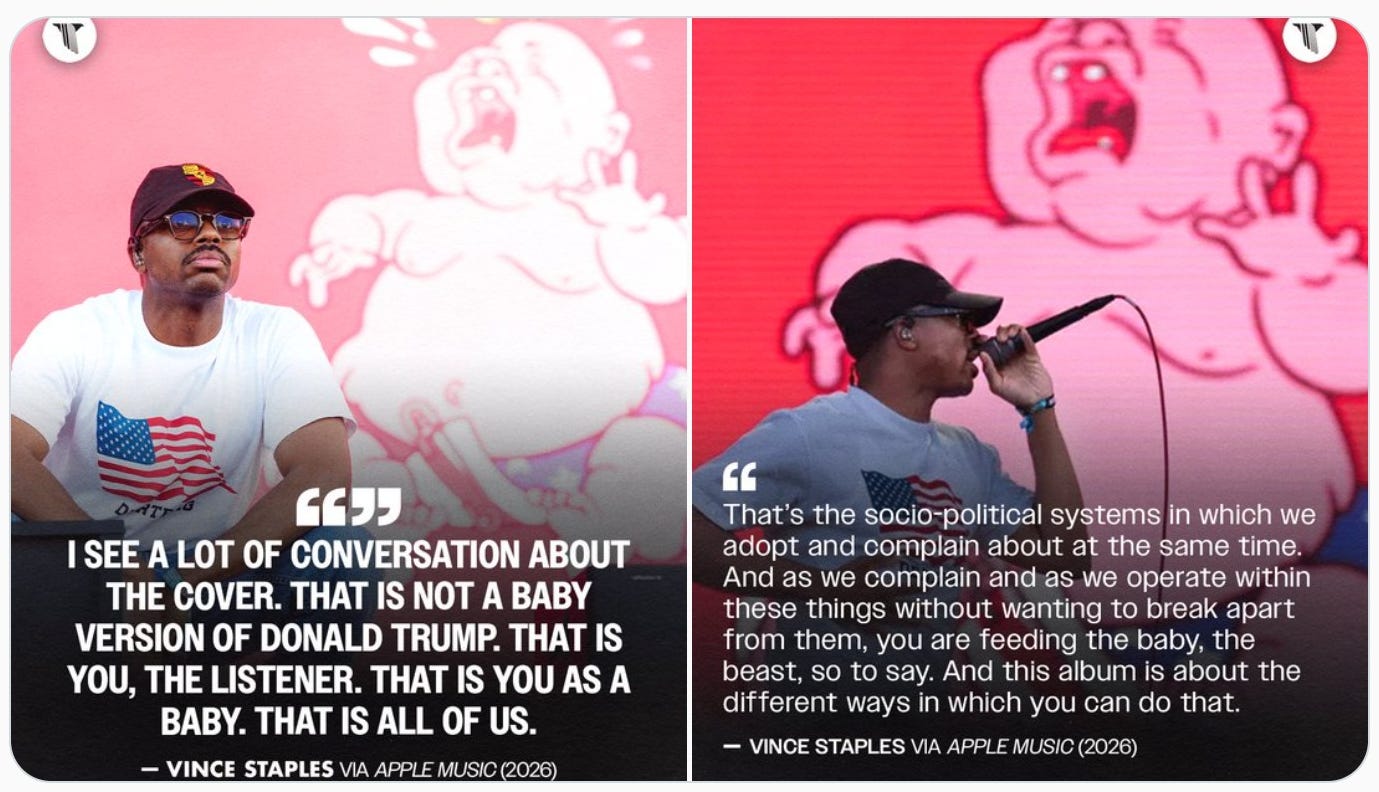
Marsh: Like what am I to learn from this album that I couldn’t learn while scrolling Instagram. That’s the issue for me. That all of the takes feel like the sort of information you get from Tik Tok where it’s just like five second headlines or, “Hey, this has happened. And this is something we really need to pay attention to. And here’s me raising awareness.” And then you flick your index finger, and it’s another thing you need to pay attention to. It’s this series of disconnected images, and frankly, the cover image is unearned because I don’t think he actually says anything aloud targeting the current administration. It’s all kind of cowardly.
Eli: Vince would be miffed about me saying this but this album is really for like white liberals and that it’s tough to hear when you’ve kind of spent your career defining yourself against you know kind of cowardly white liberals but you know, “orange man bad!” You’re right, he fucking sucks. I’m not a huge fan of hers but this isn’t like Noname or something where she’s very radical with a deeply revolutionary spirit. It just feels like something you know you’d play on Jimmy Kimmel and get them roused or something like that. It does not have the true, you know, intent, and the music and the lyrics compound themselves being this sort of blob of milquetoast firebrand.
Marsh: Exactly. Like Ellen Degeneres would have had this on her show at around the same time she invited Travis Scott on for all of these white people to nod along and think that they’re with it. I totally agree that Vince Staples would be upset by what you just said about white liberals but if he wanted it to be different, he could have gone about this album in so many different ways. Here’s a question: how is it that it’s been ten years since YG wrote “Fuck Donald Trump” and we haven’t gotten something that explicit since, and why are people treating this album like it’s ten songs on that level?
Eli: “Fuck Donald Trump” is still basically the basemark.
Marsh: The gold standard.
Eli: It’s a great basemark. If Vince really wanted to impress me even with the boring rock parts, if he were like, “I’m going to dissect Stephen Miller, and Pam Bondi is going to be put in between four horses,” then now we’re cooking. Now we’re doing some real work. Shit, this recording is going to get me investigated. That’s not the point. It’s okay. I’ve got an FBI visit before, but that’s neither here or there. Yeah, this is just so flat. Back to your point about the critics, did people just never listen to rock before reviewing this? Were they that impressed by these parts? It’s pretty embarrassing.
Marsh: And the people are saying “Oh, this is so good because it’s political.” Well, it’s not. But then, I think about it, and we don’t really get political rap music anymore, and maybe that’s the problem: people don’t remember what actual good political rap music sounds like so they hear something like this, and they’re like “Oh, this is good by the standards of a genre that is so fangless nowadays.” If this came out in 1990, and you stack it up against Public Enemy, no one would have cared.
Eli: Or the 2000s political backpacker-type rap. It’s the same thing I was saying with Olivia Rodrigo, it’s total kid gloves to this guy who’s a critical darling. Please hold people to standards! People hold people to a baseline level of craft and creativity.
Marsh: Exactly. And I get it. Staples has already done his due diligence. He’s already made good albums if not outright great albums and he can just coast now in a level of listenability for the rest of his life, and still get scores of 7.0-7.9, still get fans, still play shows, and do whatever he wants to do, but if you’re gonna make a political rap rock album, then do better.
Eli: Any closing thoughts?
Marsh: It’s not the worst rap album I’ve heard this year. It’s better than Drake’s three albums. But look, if this album starts a trend about music being a little smarter, then I’m all for it, but we all know that’s not going to happen. So unfortunately, it’s just another new thing to listen to and promptly never think about again.
Eli: People are calling me a shit writer, whatever, I don’t care, but I really do think it’s a broader point among fellow critics that people don’t treat these artists who are already beloved with the proper critique that they should, and it just puts it all into a blender and then you can hit the kind of cornball-type people with scores and everyone laughs, like finally turning on Taylor. And it’s like, where is your sense of…
Marsh: Duty?
Eli: Actual fervor. Because if you don’t have any sort of robust standards and just go with this grain, music criticism just becomes bland and corporatized, even if you’re not getting paid under the table or whatever.
Marsh: It’s been like that for a while. You hit the nail with the hammer. No critic is willing to call out anybody unless they’re easy targets. So then you get this gray zone where everything is good. Everything is very acceptable and very good to listen to. And sure! Everything sounds fine. The new album sounds fine. That’s the bare minimum! Let me tell you a secret, all music sounds good now. You know why? Because all of tech makes it so. All these producers and sound engineers are available to help your music sound good. So of course, everything sounds listenable! But that’s not enough. Have better standards.
Thanks for reading. If you like what I do, subscribe or drop me a few bucks below.
