

”I tell you this because, as an artist, I think you'll understand”
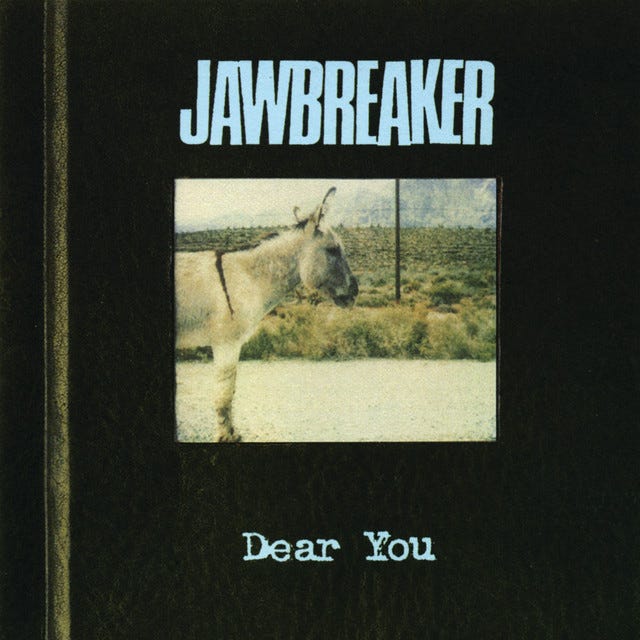
There’s a prevailing narrative around Jawbreaker, and you’ve probably heard it. They sold out. Dear You was the first and only major-label release of theirs, and tanked their reputation. They became the Bay Area pariahs; a symbol of post-Nirvana and Green Day corporate greed and what happens when you cross an implicit punk credo. Geffen executive Mark Kates recalls how, when they headlined the Roxy in Hollywood, “there were kids sitting on the floor, with their backs to the stage, when they were playing songs from Dear You. I’m not making that up.” Very few records in history have inspired this kind of vitriol.
You’d think, then, that Dear You is terrible. That it’s the punk Big Day or Chinese Democracy, a bloated waste of CD space that makes the listener question why they even liked the band in the first place. But this is the Our Band Could Be Your Life era. Pre-stans, pre-parasocial attachment, these bands represented a safe space away from mainstream culture and abject consumption that those in DIY held dear. The rawness of Jawbreaker was emblematic, unfiltered and wholly unbought. And while they were punk through and through, fans and critics likened Blake Schwarzenbach’s lyrics to Bukowski and Rimbaud, his sensitive everyman quality distinguishing the band from hyper-aggro Gilman Street contemporaries like Operation Ivy and DayGlo Abortions. Poetic enough for the college rock kids, passionate enough for the mosh pit.
Dear You, despite the reaction, isn’t a stark contrast to the rest of their discography. Sure it’s smoother, owing to Schwarzenbach’s polyp removal from years of diaphragmic violence. But for those closely listening—how different is “Ashtray Monument” and “Do You Still Hate Me?” to “Oyster” and “Sluttering (May 4th)”? It suggests a kneejerk backlash to the improved sonics and mixing their Geffen contract afforded them. Where instead of falling back on their tried-and-true Bay Area punk, they blazed a path unlike anything seen in punk at that point.
Speaking of commercial appeal, see: “Fireman”, aka the lone attempt to catapult Jawbreaker into the mainstream. It’s a wonder at all that they were ever on MTV, with such relatable lines as “Dreamed I was a fireman / I just smoked and watched you burn”. Laconic pop-punk was still about a half decade away from beingly broadly marketable. But as a single, it’s unimpeachable. It’s surely a heated pub debate, but to me, Schwarzenbach’s lyrics peaked here. I have always been of the lyrical disinterest camp—without good music or proper arrangements, they mean nothing. And punk, for all its merits, is simple, requiring only the barest lyrical sentiment or even ambition to match a great riff or beat. But every line of “Fireman” is devastating. Blake toes the fine line between devotion and creepiness, desperately trying to swallow his lover whole with no hesitation. It’s both true romance and cause for a restraining order.
Every song on Dear You hits with this same emotional collision. “I Love You So Much It’s Killing Us Both” has the propulsive force of a headbanger while a relationship not only dissipates into smoke, but is insinuated to be actively killing its inhabitants. “Hold me / Set me free / It's all I want from you /It's sad and it's so true”. Schwarzenbach’s hold on the inner workings of human romantic folly and tribulation is simply masterful. Him, Chris Bauermeister, and Adam Pfahler thread the needle with tight, Smiths-like melodies, while Blake delivers devastating anecdotes in love gone awry. No Morrissey-esque irony or humor here, simply grief.
Not that everything here is doom and gloom though. The allegations of Jawbreaker being way too emo on Dear You were a prime criticism (more on that later), but there are moments of levity and optimism strewn about that contradict this narrative. Opener “Save Your Generation” is an anti Generation-X anthem, or, at the very least, a plea to his cohorts to get their shit together. No more slacking, no more excuses, “We're killing each other by sleeping in”. In an era of cynicism, irony, and malaise, it’s an eyebrow-raising missive from Schwarzenbach, the last person you’d think would get on his high horse. But he has a bigger sense of humor than people’d think.
“Bad Scene, Everyone’s Fault” was the spiritual successor to “Boxcar” off 24 Hour Revenge Therapy. While the latter is a send-up of the purity politics and peacocking of the punk scene (a called shot?), “Bad Scene” is merely a snapshot of a tragicomic party. This is Blake just shooting the shit, mildly amused and annoyed at in-scene gossip and couple dynamics. "‘Why, why, oh why, oh why / Why is it always like this?’ / Either you're too mean or you're too nice.’ He said, ‘I even cooked her breakfast.’” It’s imagery worthy of a Whit Stillman film, despondent exes and break-ups hitting like freight trains to poor saps. A worthy rebuttal to anyone who says Jawbreaker didn’t have jokes.
And yet, Dear You cannot escape its emo legacy contributions. It is a stunningly morose album when it wants to be. Case in point: “Accident Prone”’s gut punch of an opening lyric: “What's the furthest place from here? / It hasn't been my day for a couple years / What's a couple more?”. Line after line of pure melancholy, lifting 14 year old despondency straight out of their heads. “What's the closest you can come to an almost total wreck / And still walk away, all limbs intact?” stands up their with the suicidal singer-songwriter maestros, except we thankfully still have Blake with us. It’s a wonder how this album was derided for being “too manic depressive”, as if some jamoker had never felt or never even imagined you could have psychological rot on this level.
Even a less depressed track like “Oyster” still carries weight on its shoulders. Schwarzenbach is apt to lyrically give himself over to common, and some might even say trite metaphors, yet he always squeezes the last juice out of them. “The world is an oyster / Locked in a shell / You like the taste of it /Can't take the smell” is an addicting refrain, direct in its accusations. It’s simultaneously a sly insult and an honest plea, conveying both disappointment in someone’s actions but a belief they can and will face the music. That by the end you are screaming the verse with reckless abandon doesn’t hurt either.
By now, those unattuned to the band may be wondering why I’ve barely mentioned Jawbreaker’s bassist and drummer Chris Bauermeister and Adam Pfahler, respectively. The truth is they were always the rhythm section to Schwarzenbach’s one-man band; this got so heated that Bauermeister and Schwarzenbach instigated the breakup in 1996 because of Bauermeister’s perception of Blake’s arrogance and usage of the band as his own vehicle, as documented in Don’t Break Down: A Film About Jawbreaker. I think Bauermeister was right, but that doesn’t mean they didn’t contribute substantially—”Fireman” is his finest hour, the deep, brooding bassline powering the song a la Andy Rourke. While his talents were far more apparent on past records, Pfahler is solid throughout and particularly shines on “Lurker II: Dark Son of Night”, 32nd note drum fills and the little double bass kicks adding a notable swing.
The truth is though, the most notable non-Blake member of Dear You has to be Rob Cavallo. While Geffen certainly selected him for his work on Dookie, a lesser-known album of his that may be more influential to the recording is the Muffs’ Blonder and Blonder, whose power-pop sound mirrors Jawbreaker’s here closer than Green Day’s snotty, raucous breakthrough. Especially on songs like “Chemistry” and “Lurker II”, the band sound unrecognizable, caked in reverb and modulation. And this manifests doubly with Blake’s harmonized vocals, anthemic in way that hadn’t been seen on Bivouac or 24 Hour Revenge Therapy, despite the legendary status of “Condition Oakland”.
Everything prior leads up to “Jet Black”. Prefaced by the Christopher Walken quote from Annie Hall, it is, if not Jawbreaker’s, than Blake Schwarzenbach’s most naked musical statement. So much of the coming years of emo, in both form and function, stems from this cut. The description of physicality in pain, the black humor, the melodrama, the unflinching baring the soul. When Blake says “White noise in black room dust / These hands long for one last touch”, it either triggers a guffaw or a neurological recognition of every relationship you have ever fucked up. Schwarzenbach’s hospital metaphors consecrate a major defining theme: what is love if you’re not willing to die for it. The haters can score one here, if they want—it’s melodrama incarnate, the product of 50,000 bad emo songs. But if you fuck with Gerard Way, Chris Carabba, Jim Adkins or Chris Conley, this is the incubation of their artistry.
I hinted at it beforehand but this is also the product of a longstanding grudge versus Christopher Sebela, the writer of Pitchfork’s review of the 2004 reissue of Dear You (which features an excellent cover of the Psychedelic Furs’ “Into You Like A Train”). It reads as parody: the line “"Sluttering" and "Fireman" are love-as-revenge songs in the key of Sylvia Plath.” is supposed to be a put-down instead of a massive compliment, and it ends with the assertion “the disintegration of Jawbreaker was not worth mourning, especially with so many bands gladly assuming their former position in the underground.”, which is so clearly untrue I can scarcely believe it to have been written with 9 years of hindsight. Given the Pitchfork of 2004’s complete distaste for emo I’m not surprised at the tone, but 13 year old Eli needed 29 year old Eli to make a point; this review STINKS.
If you’d pardon my pettiness, time has done Dear You its justice. There’s little a band over emo’s short history it hasn’t touched; from golden era icons like Texas Is The Reason and the Get Up Kids, to mallcore behemoths Fall Out Boy and Paramore, to emo revival’s Title Fight and Joyce Manor. Hell, Jawbreaker Reunion picked their name because it was so improbable and yearnful they’d ever come back to us. I was lucky enough to see that reunion at Riot Fest in Chicago, and god, what a dream. It’s hard to point to a band whose legacy is so canonical, so revered as Jawbreaker, who, despite their cult status, could command widespread bliss at reuniting.
Sitting here in 2026, it’s weird to write this love letter about an album that now has been solidified as gold-plated. We already know Dear You is a classic, Eli, who cares? But for a long time, that wasn’t the case, even disregarding that Pitchfork review. Blake moved on to his Jets to Brazil project, and the excellent Orange Rhyming Dictionary, yet Dear You sat as the black sheep of the family next to 24 Hour Revenge Therapy’s honor student, a reminder these guys sold out. As every new generation finds out how cathartic it is to get their heart stabbed out by these lyrics, the deserved acclaim will crowd out the bitter resentment this album accumulated. Until the tide is completely turned, I will sing Dear You’s praises to high heaven, cause if you’ve heard it hundred times it still won’t be enough.
We already know Dear You is a classic, Eli, who cares?
Just teasing. Great piece. I understood why punks hated this record at the time, but it's always seemed pretty clear that the hate was largely ideological and had very little to do with the record itself.
great review