

Let’s play a game: what do you think Vogue’s expenditures are? Given their status as Conde Nast’s flagship publication, iconic branding, event coordination at fashion weeks New York, London, Paris, and now Dubai, and importance toward the entire iconography of the world of fashion, we can safely guess in the hundreds of millions. Now, what do you think Pitchfork’s are? Does it reach double digit millions? I can’t imagine, given freelancers are paid around $200 for reviews and they had to cut the number of daily reviews from 5 to 4. So why exactly did Conde Nast give the mandate to paywall?
It screams a venture capital pursuit, the kind that the ratfuck Jim Spanfeller would think up in order to showcase a massive 2% growth in site traffic before the house of cards collapses after the audience wizens up. To be clear, this is not a criticism of the great Pitchfork staff, of whom I respect and have seen a wonderful evolution from under No Bells’ own Mano Sundaresan. But seriously though, what a lame duck maneuver. Forcing a website to capitulate to portfolio gains destroys audience trust and retention, cheapening the value of the criticism that has so reliably come from the outlet. When sites like the Wire, Stereogum, and Hearing Things introduce paywalls and subscriber-only benefits, their independent status makes it understandable and fair for the writers. When a publication owned by a billion-dollar conglomerate does it, it’s just a slap in the fucking face.
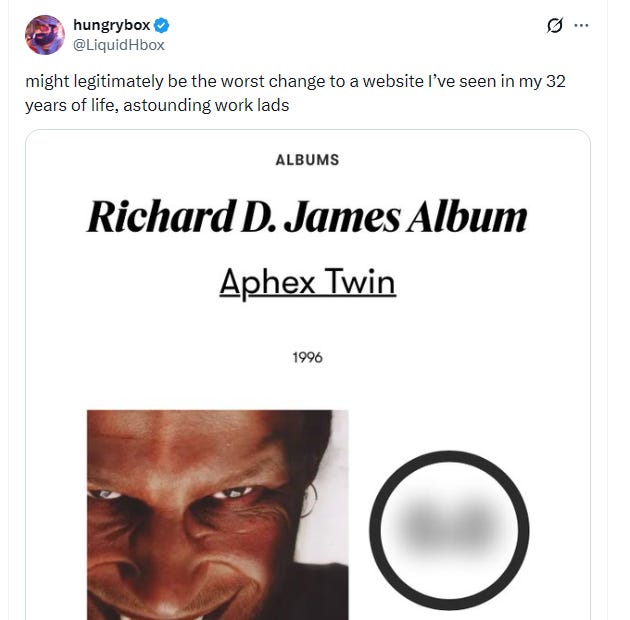
And the user scores introduction is even worse. Why does Pitchfork have to be RateYourMusic or Albumoftheyear? You already see enough of the stan opinions in every quote tweet of wafflingly positive to middling reviews of their fave’s albums, this just makes it that much worse. What is the point of the score then! People are now even less inclined to read the reviews given the dichotomy between the writer’s score and the reader’s score, it’s all so trashy. Undermining the authority of the critic makes the piece feel useless, just another take in a sea of noise instead of something that the outlet stands by.
As I was writing this, Jaime Brooks also published a piece on this exact topic.

It’s well worth your time, and she’s a brilliant writer (and musician who’s been covered by Pitchfork herself!) but I have some contradicting thoughts. I think it’s noteworthy and agreeable that she disabuses herself of the fantasy of getting paid to write about music, and how that has been the defining struggle of the Internet-age music critic; the notorious shithead Chris Ott famously said 10 years ago that you’d be able to get a job at Starbucks and be more financially solvent and less compromised by corporate advertising than simply working at Pitchfork. But, I do disagree that Conde Nast shouldn’t have to keep subsidizing Pitchfork—what is the point of owning it then? It’s not as if they were Rolling Stone and acquired it to monopolize competition, they were just scared of being left in the past vis-a-vis Internet cultural capital.
Does this frame me as someone who believes in noblesse oblige? Perhaps, but there are still publications out there with the taste and good sense to play to their audience and not destroy any goodwill they have left. It makes sense when the New York Times and GQ pivot towards a paywall, their older consumers have the money and investment to actually pay for it. Do you think weirdo 14 year olds like I once was who check Pitchfork every day can? Even economically, the gamble makes no fucking sense.
Once again, I don’t blame Mano or the staff for this debacle. And I especially feel bad for the freelancers who have been writing for the site near on decades and will now have to find alternate ways to link their articles from 2008. But it just speaks to a larger problem within music writing and writing in general. Unless you command parasocial attachment, your writing is not being paid for. And that’s a tough pill to swallow for a lot of us. The noble cause of a Tiny Mix Tapes cannot be sustained, and if you don’t have a built-in audience for your Substack, good fucking luck (subscribe btw!). In the end, music taste and curation has been forced into nooks and crannies, where the best stuff continually gets unearthed like bugs skittering out of rocks. Good luck to Pitchfork, and check back here in 2027 where we undoubtedly see another controversy befall the website, courtesy of Conde Nast management.
nailed it
What did Chris Ott do to you